Structured Argumentation
Build a position that holds under cross-examination in the boardroom, not just one that sounds good in the briefing note.
CDC for Professionals
It only cares whether you can make the case. Structured communication and debate training for working professionals — from a platform that has put Kolkata speakers on the same stage as Oxford, Cambridge, and Harvard.
Why Most Professionals Plateau
At a certain point in every career, technical expertise stops being the differentiator. What separates the people in the room from the people running it is not knowledge. It is the ability to communicate that knowledge under pressure — in a boardroom, in a negotiation, in front of a panel that is not already on your side.
Most professional communication training teaches you to sound confident. It does not teach you to argue. The difference is enormous. Sounding confident gets you through a presentation. Arguing properly wins the pitch, the policy, the room.
That is the gap CDC was built to close. And unlike a public speaking workshop, we do it under real conditions — a structured debate, a live audience, and an opposing case that will not go easy on you.
What You Learn
CDC professional training is built around the mechanics of structured argument — not theory, not role-play, but the skills that transfer directly to every high-stakes professional conversation you will ever have.
Build a position that holds under cross-examination in the boardroom, not just one that sounds good in the briefing note.
When the opposing case is strong and the room is watching, learn to identify the weakest point and dismantle it without losing your composure.
The difference between winning an argument and losing a relationship. Learn when to press, when to concede, and how to do both with authority.
Most professionals prepare what they will say. Trained debaters prepare for what the other side will say. That is the advantage.
Speak to a live audience that includes people who disagree with you. Manage the room, the nerves, and the clock, simultaneously.
The skill that separates senior professionals from everyone else: the ability to form a coherent, defensible position in real time, without preparation.
How It Works
CDC professional workshops are small, structured, and taught by trustees with competitive debating and professional backgrounds. You work on argument construction, rebuttal, and delivery in a controlled environment before you are ever asked to perform.
CDC stages public debates where professional members argue real motions in front of a live audience. This is not a simulation. The audience is real, the opposition is real, and the motion is one that people in the room actually care about.
CDC draws lawyers, doctors, academics, journalists, and business leaders into the same room. Not for networking in the conventional sense — but because the kind of person who chooses to argue better in public is usually the kind of person worth knowing.

Who Should Join
What Professionals Say
“I have sat across negotiating tables for twenty years. CDC was the first training I have done in a decade that actually changed something about how I argue — not how I present, how I argue.”
“The public debate format is what makes it different. Anyone can practise in a workshop. Arguing a motion in front of an audience that is free to disagree with you is another thing entirely. That is where the training becomes real.”
From the Floor
Dr. Subramanian Swamy vs. Dr. Kunal Sarkar. Public policy, economics, and the direction of the country — argued publicly, in Kolkata.
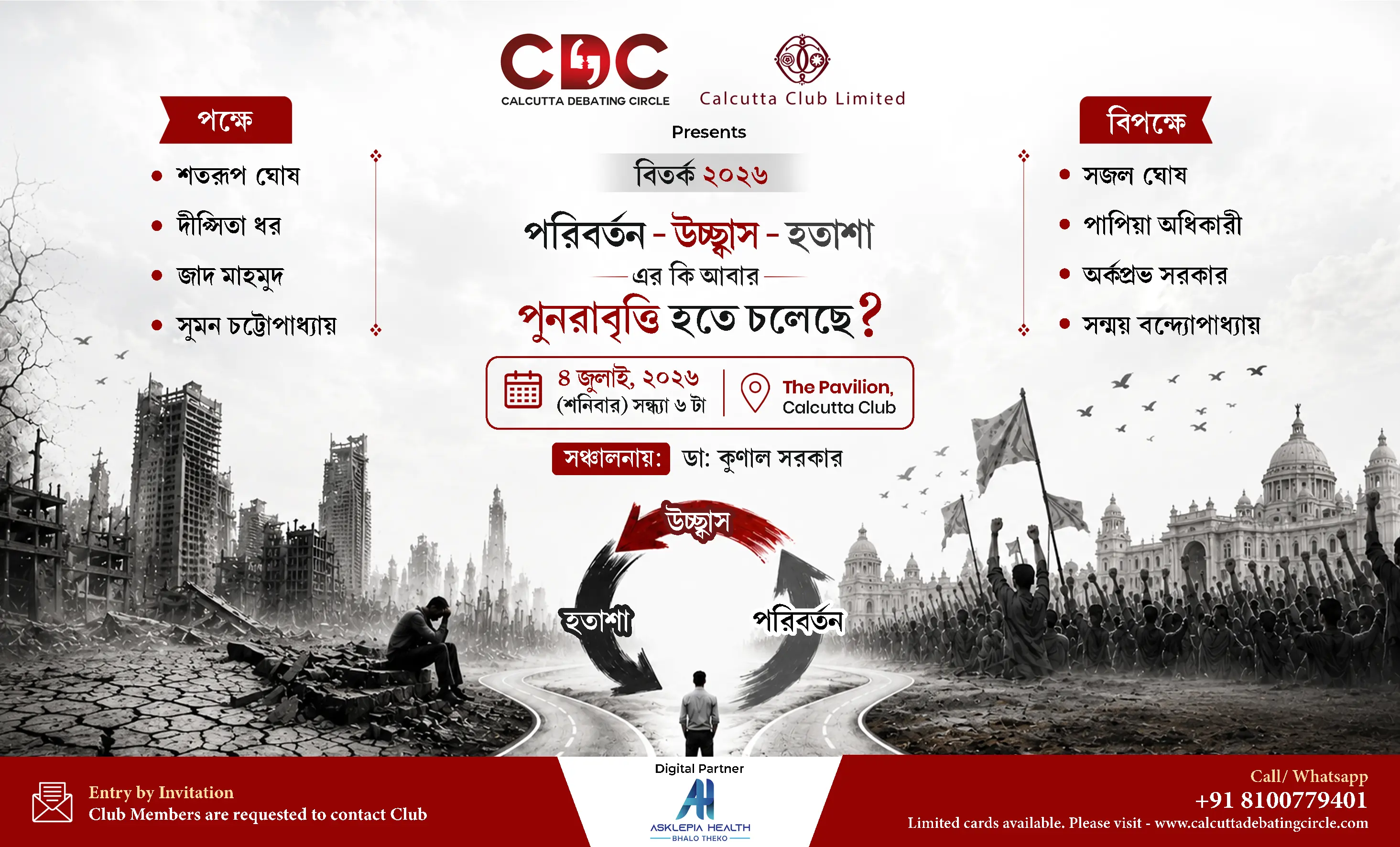
Motion: Is democracy a series of conflicts? Professional members on the same stage as international visiting debaters.
Motion: News is dead, long live fake news. A public debate on media, truth, and how we form opinion in the digital age.
One of CDC's most-attended public forums. A motion that drew professionals from law, media, and public service.
The Floor Is Open
Apply for professional membership. Or attend a public debate as a guest first. Either way, the conversation starts here.